Automation has become a fundamental part of modern business operations, helping organizations improve efficiency and reduce manual effort. Over time, companies have relied on traditional automation tools such as scripts and workflow systems to manage repetitive tasks.
However, a new and more advanced approach is emerging: AI agents.
To make informed decisions about automation strategies, businesses must clearly understand the difference between AI agents and traditional automation.
What Is Traditional Automation?
Traditional automation operates on predefined rules and structured logic:
If an event occurs → perform a specific action
For example, when a user submits a form, the system may automatically send an email, update a CRM, and notify the relevant team. This approach is highly effective for predictable and repetitive workflows.
However, traditional automation has limitations. It lacks the ability to understand context, adapt to changing conditions, or make decisions beyond its programmed instructions.
What Are AI Agents?
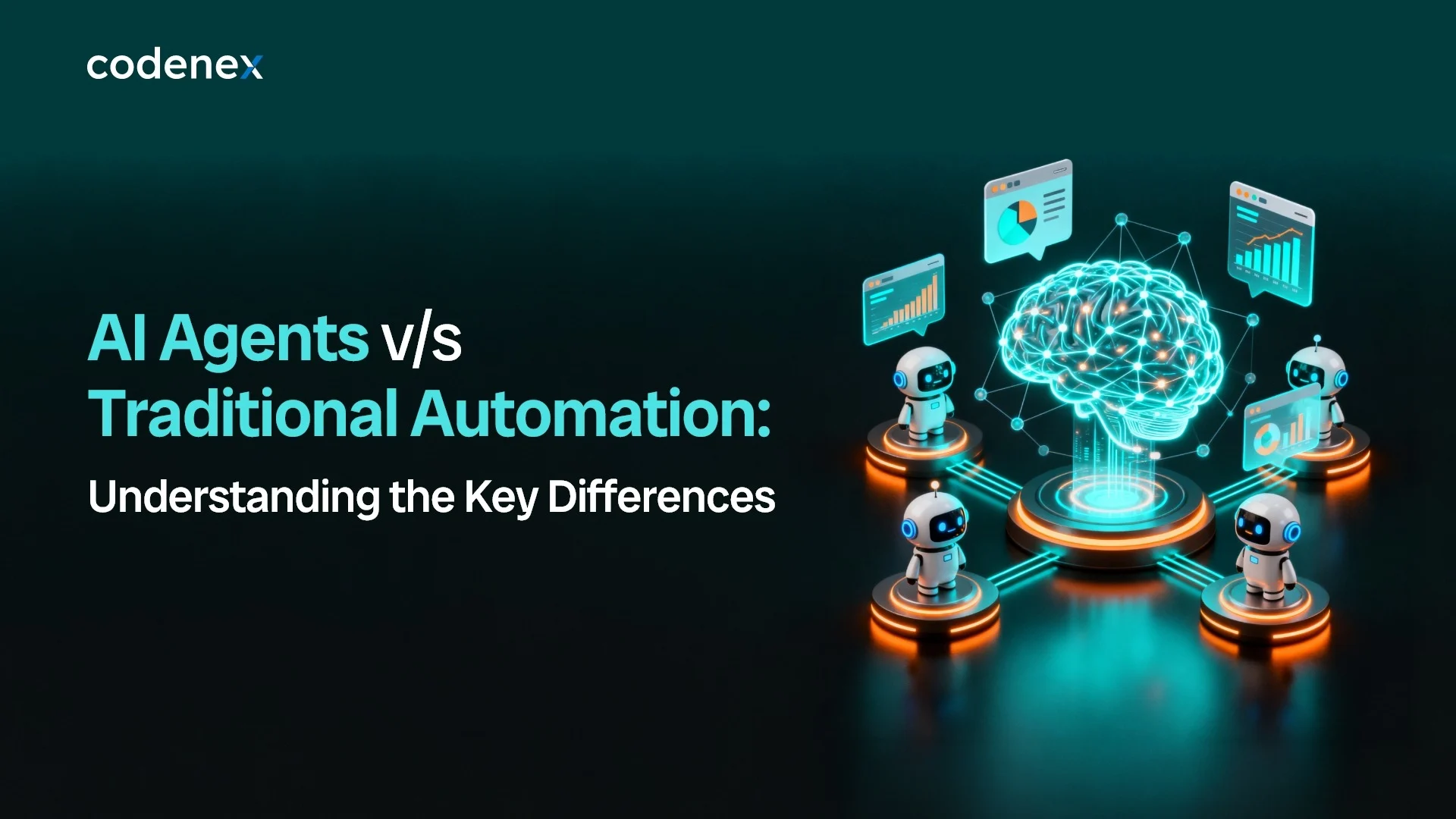
AI agents represent a more advanced and intelligent form of automation. Unlike rule-based systems, AI agents can:
- Observe events
- Analyze context
- Make decisions
- Execute actions
For instance, if a system issue occurs, an AI agent can detect the problem, analyze underlying causes, attempt corrective actions, and notify the team with detailed insights.
This enables a shift from static automation to dynamic, decision-driven operations.
Key Differences Between AI Agents and Traditional Automation
Understanding these differences is essential for selecting the right approach:
1. Decision-Making
Traditional automation executes predefined actions.
AI agents evaluate situations and determine the most appropriate response.
2. Context Awareness
Automation tools operate without contextual understanding.
AI agents analyze multiple data points, including system data, user behavior, and historical patterns.
3. Flexibility
Traditional workflows require manual updates when conditions change.
AI agents can adapt automatically to evolving scenarios.
4. Monitoring Approaching
Traditional systems respond only when triggered.
AI agents continuously monitor systems and act proactively.
When to Use Traditional Automation
Traditional automation remains effective for simple, structured, and repetitive tasks, such as:
- Sending transactional emails
- Synchronizing data between systems
- Scheduling routine processes
- Managing standard workflows
These tasks do not require complex decision-making or adaptability.
When to Use AI Agents
AI agents are better suited for complex and dynamic environments, including:
- Infrastructure monitoring
- Customer support systems
- Lead qualification
- Fraud detection
- Business analytics
In these scenarios, AI agents enhance efficiency by making real-time, context-driven decisions.
The Future: A Hybrid Automation Model
The future of automation lies in combining both approaches.
Organizations will increasingly adopt a hybrid model where:
- Traditional automation handles predictable, rule-based tasks
- AI agents manage complex, decision-driven operations
This approach enables businesses to build systems that are both efficient and scalable.
Key Takeaways
The primary difference between AI agents and traditional automation lies in intelligence and adaptability. While traditional automation is rule-based, AI agents can observe, analyze, and act independently.
As business environments become more complex, AI agents will play a critical role in shaping modern automation strategies.
Get Started with AI-Driven Automation
AI-powered automation is rapidly becoming a competitive advantage. It enables organizations to streamline operations, reduce manual workload, and improve decision-making speed.
If your business is exploring AI agents or OpenClaw-based solutions, Codenex can help design and implement scalable, future-ready automation systems tailored to your operational needs.